
Interiors (1978)
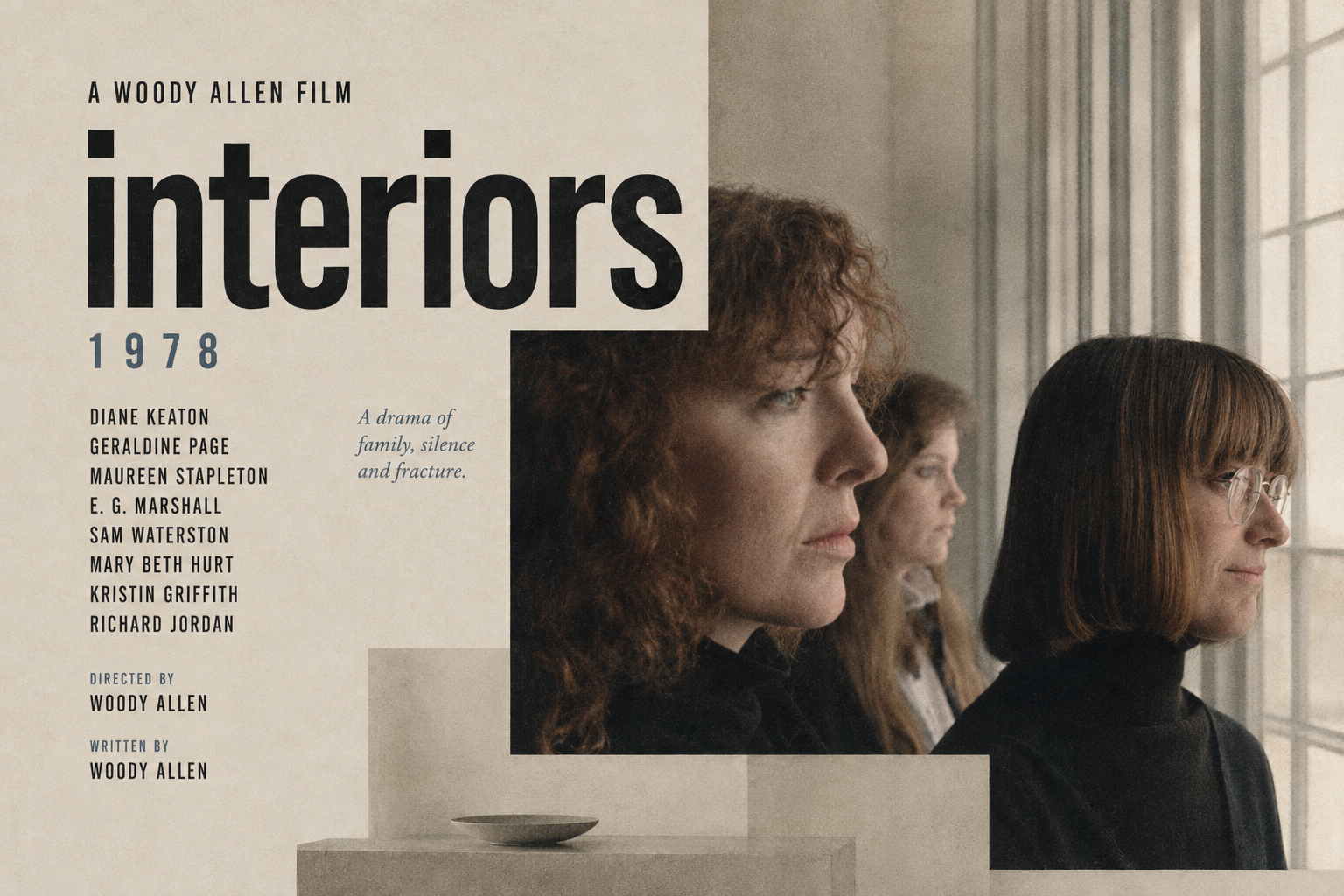
Film Overview
After the enormous success of Annie Hall, Woody Allen made perhaps the least predictable follow-up possible: a quiet, severe family drama with almost no comedy and without Allen appearing on screen.
Interiors centres on Arthur and Eve and their three adult daughters, Renata, Joey and Flyn. Their carefully ordered family begins to fracture when Arthur announces that he wants to separate from Eve, an interior designer whose need for control has shaped both the spaces around her and the emotional lives of her children.
Renata is a successful poet increasingly preoccupied with death and the value of her work. Joey struggles to find a creative direction of her own, while Flyn has built a career as an actress. Each daughter responds differently to the collapse of the family structure they have always known.
The balance changes again when Arthur returns from a trip with Pearl, a warm, direct and socially uncomplicated woman whose personality is the opposite of Eve’s carefully controlled world.
Gordon Willis’s restrained photography and Mel Bourne’s production design are central to the film. Rooms, windows, furniture, colour and empty space become part of the drama, giving the title a significance that extends far beyond Eve’s profession.
Watch Interiors
My Review
The silence after Annie Hall
I have always found Interiors one of the most fascinating films in Woody Allen’s career, partly because of the film itself and partly because of when he chose to make it.
Annie Hall had just become an enormous critical success. It had won the Academy Award for Best Picture, Allen had won for directing and the film had demonstrated that his comedy could become emotionally complex without losing any of its humour.
The obvious next move would have been another comedy in roughly the same territory. Instead Allen made Interiors, removed himself entirely from the cast and stripped away almost every comic protection he had previously relied upon.
There are no nervous monologues to the camera, no surreal digressions, no stand-up rhythms and almost none of the musical warmth that had become associated with his films. The result can initially feel almost austere.
That austerity is deliberate. Interiors is a film about people trying desperately to control emotions that will not remain contained, and almost everything in the filmmaking reflects that tension.
The rooms in Interiors are beautifully controlled because the people living inside them are not.
The comparison with Ingmar Bergman is impossible to avoid. Allen clearly admired Bergman, and Interiors makes that influence visible in a way few of his other films do. The family tensions, the seriousness, the close attention to faces and the willingness to leave silence hanging between characters all invite the comparison.
But I think the film becomes much more interesting once you stop treating that influence as the entire explanation for it. Beneath the European severity is a very specific Allen concern: intelligent, articulate people who can analyse almost everything except the thing that is making them unhappy.
Eve is at the centre of that world. Geraldine Page gives an extraordinary performance because she never reduces Eve to simply a fragile or difficult mother. Her need for order is both professional and emotional.
She is an interior designer, but the job feels almost too perfectly chosen. Eve does not simply arrange furniture. She seems to believe that if the environment can be made sufficiently correct, restrained and tasteful, then perhaps life inside it can also be kept under control.
The film quietly demonstrates how impossible that is.
Gordon Willis photographs these spaces with extraordinary discipline. People are repeatedly framed by windows, walls and doorways. Rooms often feel larger than the people occupying them, yet somehow claustrophobic at the same time.
It is one of those films where the design never feels like decoration. The houses tell us something about the family before the characters have explained themselves.
Eve’s influence seems to exist everywhere. The pale colours, careful furniture and absence of clutter suggest a life from which anything uncontrolled has been removed.
Unfortunately, emotions cannot be arranged as easily as rooms.
Eve can redesign a room until everything is in its proper place. She cannot do the same thing with a family.
E. G. Marshall’s Arthur sets the crisis in motion almost quietly. His decision to separate from Eve is devastating precisely because he does not deliver it with melodramatic force. He simply wants another life.
To Arthur, the separation is an attempt to breathe. To Eve, it is the destruction of the structure around which she has built her identity. To their daughters, it forces old loyalties and resentments back to the surface.
Diane Keaton’s Renata is perhaps the daughter who seems most successful from the outside. She is a respected poet, married to Frederick and apparently living the kind of serious artistic life the others might envy.
Yet Renata is deeply anxious about her work and increasingly obsessed with mortality. Success has not given her certainty. If anything, it seems to have created another standard she now fears she may no longer be able to meet.
Keaton is excellent because there is almost nothing of Annie Hall in the performance. The looseness and spontaneity have gone. Renata is measured, watchful and inward-looking.
Mary Beth Hurt’s Joey interests me even more. Joey has not found the same professional identity as Renata and cannot escape the sense that everybody around her possesses some creative certainty that she lacks.
She wants to do something meaningful but cannot settle on what that something should be. That uncertainty becomes tangled up with her feelings towards Renata, her relationship with Michael and, most of all, her complicated attachment to Eve.
There is a painful recognisability in Joey’s frustration. She is not without talent or intelligence. Her problem is that she cannot locate the form in which those qualities should exist.
Allen would return many times to artists worried about whether their work matters, but in Interiors those anxieties feel unusually exposed because there are no jokes to release the pressure.
Interiors is full of people who can explain their unhappiness far more easily than they can change it.
Kristin Griffith’s Flyn occupies a slightly different position within the family. As an actress she seems less intellectually burdened than her sisters, but that does not make her life uncomplicated. Her presence also exposes tensions that have been sitting beneath the surface of Renata’s marriage.
Richard Jordan’s Frederick is one of the film’s more uncomfortable figures because his dissatisfaction expresses itself through his attraction to Flyn. The emotional boundaries within this family are constantly being tested, crossed or quietly resented.
Sam Waterston’s Michael has his own frustrations, particularly with Joey’s inability to decide what she wants from her life. Nobody in Interiors is entirely free from the temptation to diagnose everybody else.
Then Maureen Stapleton arrives as Pearl and the entire film seems to change temperature.
I think Pearl is one of the key reasons the film works. She could very easily have been presented as vulgar comic relief: louder than Eve, less refined, less interested in artistic seriousness and completely unconcerned with the family’s established codes of behaviour.
Stapleton makes her something much more important.
Pearl is alive in a way many of the other characters are not. She talks, laughs, eats, dances and occupies physical space without apologising for it. Her lack of refinement becomes almost irrelevant because she possesses warmth and emotional directness that the family desperately needs.
The contrast with Eve is not simply between good taste and bad taste. It is between control and vitality.
The famous dinner sequence captures this beautifully. Pearl enters a world governed by invisible rules she neither understands nor particularly cares about. Her presence makes everybody else suddenly aware of just how rigid those rules have become.
The broken object at the dinner table is a perfect visual expression of what Pearl represents. Something carefully chosen and carefully preserved is disrupted by a person who simply does not share the family’s reverence for it.
And yet Pearl is the person who ultimately proves most capable of responding when the crisis becomes real.
Pearl seems completely wrong for Eve’s world, which may be exactly why she is the person capable of bringing life back into it.
The sea is present throughout Interiors almost like another character. The beach house looks outward towards it, and Willis keeps returning to windows and horizons that suggest both freedom and danger.
Water becomes especially important because the family spends so much of the film attempting to contain everything. The sea is the opposite: vast, uncontrolled and indifferent to their carefully constructed interiors.
By the time Eve walks towards it, the connection feels inevitable. The moment is devastating partly because Allen refuses to turn it into conventional melodrama.
Joey’s attempt to save her mother brings the film’s emotional tensions into physical form. For much of the story she has struggled to work out what responsibility she owes Eve and how much of her own life has been shaped by that responsibility.
Suddenly there is no time left for analysis.
Pearl’s response matters just as much. The woman who seemed least compatible with this family becomes the person capable of acting instinctively when action is required.
There is something almost cruelly precise about that reversal.
I also admire Allen’s decision to use so little music. Most filmmakers would have been tempted to tell us how to feel during many of these scenes. Interiors largely refuses.
Voices, footsteps, rooms, wind and the sound of the sea are allowed to carry emotional weight themselves. When source music does appear, it feels as though it belongs to the physical environment rather than being placed over the film to manipulate us.
That restraint makes the film demanding, but it also gives it a remarkable consistency. Everything seems designed to keep us inside the emotional temperature of the family.
I understand why Interiors divided audiences in 1978. Coming immediately after Annie Hall, it must have felt almost confrontational. Allen had proved he could make one of the great romantic comedies and then appeared determined to demonstrate that he was not going to remain inside that category.
There are moments when the seriousness feels almost too deliberate, and I do not think every scene has the natural ease of Allen’s best dramatic writing. The Bergman influence can occasionally sit very close to the surface.
But I would much rather have the ambition of Interiors than a safe attempt to repeat what had already worked.
It changed the possibilities of Allen’s career. Once he had made this, there was no longer any reason to assume that a Woody Allen film had to be a comedy, had to star Woody Allen or even had to contain the familiar musical and verbal rhythms of his earlier work.
And the film has grown on me because the things that initially make it seem cold are precisely the things that give it its identity.
The rooms are cold because the family has spent years learning how to keep emotion under control. The silences are uncomfortable because the characters have reached the limits of what analysis can solve. The absence of music leaves nowhere to hide.
Then Pearl arrives, the windows open emotionally, and for a moment the film seems to recognise that life cannot be designed in advance.
That is what stays with me most about Interiors. The title initially seems to refer to rooms, furniture and Eve’s profession. By the end it feels equally concerned with the private spaces people construct inside themselves.
Those interiors can be beautiful. They can also become prisons.
Cast and Characters
Geraldine Page
An interior designer whose emotional fragility and need for order sit at the centre of the family crisis.
Diane Keaton
A successful poet increasingly troubled by mortality, creative doubt and the emotional demands of her family.
Mary Beth Hurt
Eve’s daughter, struggling to find a creative identity of her own and to understand her complicated relationship with her mother.
Kristin Griffith
The third sister, an actress whose return to the family exposes tensions that have remained largely unspoken.
E. G. Marshall
The family patriarch whose decision to separate from Eve sets the emotional crisis of the film in motion.
Maureen Stapleton
Arthur’s new partner, whose warmth, physicality and directness provide a striking contrast to Eve’s carefully controlled world.
Silence becomes part of the architecture
Interiors has no conventional original score. Allen uses music extremely sparingly, allowing voices, rooms, pauses and the sound of the sea to carry much of the film’s emotional weight.
No Original Score
The absence of conventional scoring is one of the film’s most distinctive choices. Allen refuses to place an emotional soundtrack over the family’s conflicts, leaving the performances and carefully controlled spaces unusually exposed.
When music appears, it belongs to the room
Rather than using a composer to guide the audience emotionally, Interiors relies on a small amount of existing recorded music.
Keepin’ Out of Mischief Now, written by Fats Waller and Andy Razaf, is heard in a recording by Tommy Dorsey and His Orchestra.
Wolverine Blues, associated with Jelly Roll Morton, is heard in a recording by The World’s Greatest Jazz Band.
Keepin’ Out of Mischief Now
Heard in a recording by Tommy Dorsey and His Orchestra, one of the film’s very few pieces of identifiable music.
Wolverine Blues
Performed by The World’s Greatest Jazz Band and used as source music rather than as dramatic scoring.
The Rooms
Footsteps, conversations and long pauses become unusually noticeable because there is so little music competing with them.
Silence
The film’s restraint leaves its characters emotionally exposed and makes the sound of the sea especially powerful when it enters the drama.
Locations
The homes in Interiors are more than locations. Allen and production designer Mel Bourne use them as extensions of the people living inside them.
The production filmed across New York City, Westchester and Long Island, using real homes whose architecture could support the film’s restrained visual language.
New York City
Principal photography began in New York City in October 1977, with Manhattan providing several of the family’s homes and workplaces.
Central Park West
An apartment on Central Park West was one of the four principal homes selected for the film.
West 19th Street
A loft on 19th Street provided another of the carefully chosen New York interiors.
Westchester
A Westchester home was used for Renata’s house, extending the film’s domestic world beyond Manhattan.
Southampton
The Village of Southampton provided the setting for the family’s beach-house sequences and some of the film’s most important images.
The Beach House
Production designer Mel Bourne considered around fifty properties before selecting the large turn-of-the-century house used for the family’s coastal home.
Awards and Recognition
Five Nominations
Interiors received five Academy Award nominations, remarkable recognition for Allen’s first full dramatic feature.
Best Director
Woody Allen received his second consecutive nomination for directing following his win for Annie Hall.
Best Original Screenplay
Allen was nominated for Screenplay Written Directly for the Screen.
Geraldine Page
Page received a Best Actress nomination for her performance as Eve.
Maureen Stapleton
Stapleton was nominated for Best Supporting Actress for her performance as Pearl.
Art Direction
Production designer Mel Bourne and set decorator Daniel Robert were nominated for the film’s carefully controlled visual environments.
Geraldine Page Wins
Page won the BAFTA Award for Best Supporting Actress for her performance as Eve.
A Radical Change of Direction
Coming immediately after Annie Hall, the film established that Allen’s career would not be limited by genre, tone or the need for him to appear on screen.