
Love and Death (1975)
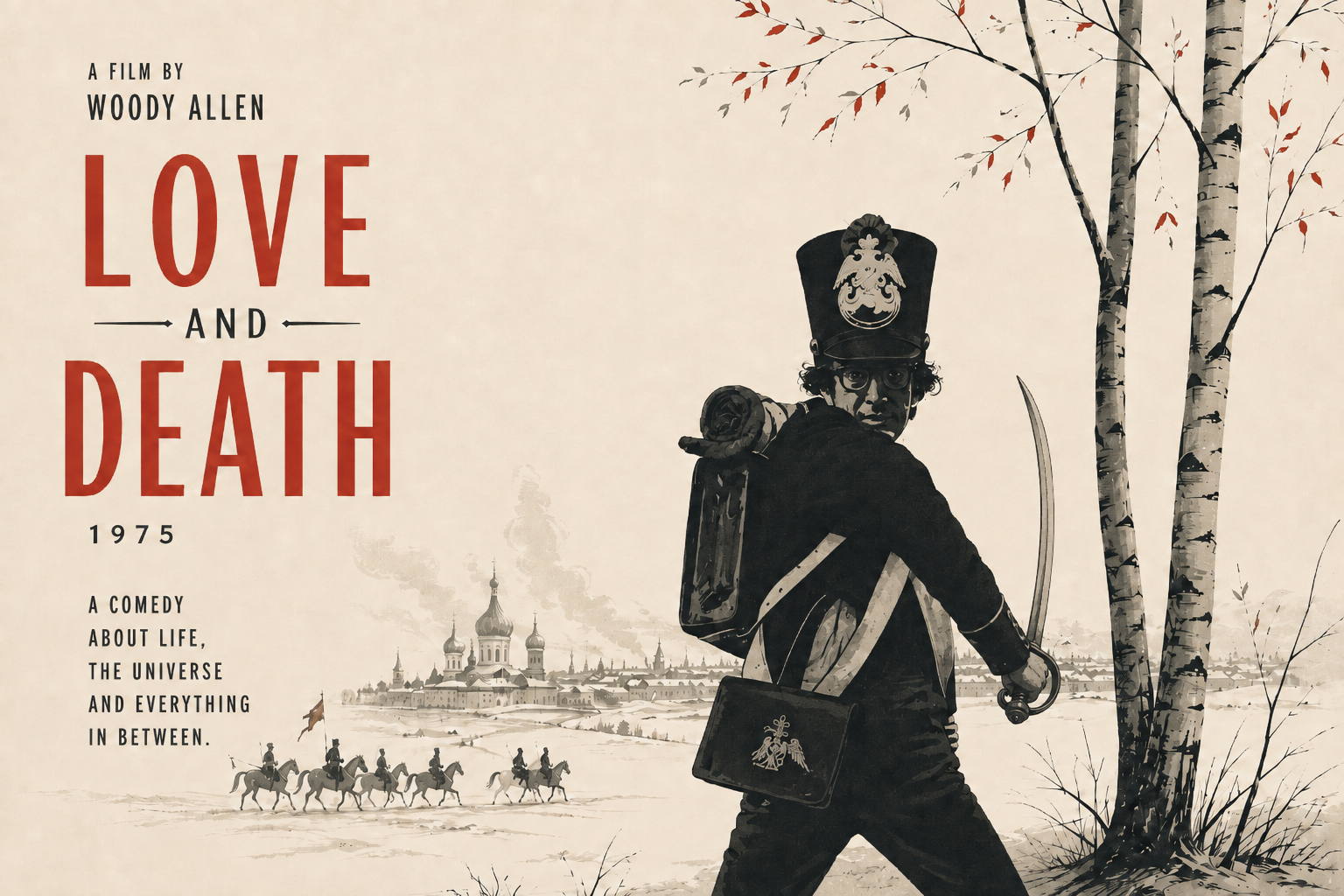
Film overview
War, philosophy and the problem of staying alive
Love and Death takes Woody Allen into nineteenth-century Russia for a wildly comic collision of war, romance, philosophy and Russian literature. Allen plays Boris Grushenko, a nervous, intellectual coward surrounded by a family that regards military glory with considerably more enthusiasm than he does.
Boris is hopelessly in love with his cousin Sonja, played by Diane Keaton, but she has other romantic plans. When Napoleon invades Russia, Boris is reluctantly swept into the army and somehow becomes a war hero despite having almost no desire to fight anyone. His adventures eventually bring Boris and Sonja together, although marriage does little to stop either of them arguing about love, morality, God and the meaning of existence.
The story draws freely on Tolstoy, Dostoyevsky and the conventions of epic Russian fiction, while repeatedly undermining them with absurdity, anachronisms and Allen's modern anxieties. Philosophical discussions become elaborate comic routines, battlefield heroism collapses into slapstick, and a plan to assassinate Napoleon gives Boris and Sonja an opportunity to debate whether murder can ever be morally justified.
Alongside the literary parody are references to European cinema, particularly Ingmar Bergman and Sergei Eisenstein, while the music of Sergei Prokofiev gives the comedy an unexpectedly grand scale. At the centre of it all is the partnership between Allen and Keaton, whose rapid exchanges allow the film to move effortlessly between broad comedy and mock-serious arguments about some very large questions.
Watch Love and Death
My review
Finding something serious inside the absurd
Love and Death is one of the films I find easiest to return to because it is simply so funny. The jokes arrive almost continuously, yet underneath all of them are questions that Woody Allen would keep returning to for the rest of his career: God, death, morality, love and whether any of us really understand what we are doing here.
Boris Grushenko is one of Allen's great comic creations. He is intelligent enough to question everything around him but far too frightened to cope with the answers. While everybody else seems prepared to march enthusiastically towards war and glory, Boris would much rather stay alive.
That basic idea gives Allen an almost perfect character to drop into an epic Russian setting. Boris is surrounded by soldiers, aristocrats, philosophers and people discussing honour and destiny, while his main concern is avoiding anything likely to result in his death.
Diane Keaton is every bit as important to the film. Sonja can move from romantic melodrama to philosophical argument to complete absurdity without ever seeming to change character. The speed of the exchanges between Allen and Keaton is extraordinary, and their scenes together have the feeling of two performers who completely understand the rhythm the other is working at.
Their discussions about love are particularly funny because the language often sounds enormously serious while the situation becomes increasingly ridiculous. Allen takes the weighty emotional world of Russian literature and keeps puncturing it with very modern neuroses.
The same trick works with philosophy. Boris and Sonja can begin by discussing morality, existence or the possibility of God and end up somewhere completely unexpected. The film constantly allows an apparently serious idea to survive just long enough for Allen to find the joke hidden inside it.
Yet I don't think the philosophical material is there merely to be mocked. Allen is clearly fascinated by these questions. The comedy comes from the fact that Boris desperately wants certainty about things for which certainty may be impossible.
The scale of the film also makes it stand apart from Allen's earlier comedies. There are armies, battlefields, grand houses, period costumes and sweeping landscapes, but he keeps placing his very recognisable New York comic persona in the middle of all of it. That collision is funny before Boris even opens his mouth.
Some of my favourite moments come from Allen's willingness to abandon realism completely. Characters address the audience, visual jokes interrupt scenes and the film repeatedly reminds us that this is a comedy playing with the conventions of a much grander kind of movie.
The references to European cinema add another layer. Allen is clearly enjoying the imagery and seriousness associated with filmmakers such as Ingmar Bergman while simultaneously refusing to behave himself inside that world.
The result is a film that can move from an elaborate parody of nineteenth-century Russia to a completely silly verbal joke without seeming to change direction. That freedom is part of what makes it feel so energetic.
Prokofiev's music is a huge part of the pleasure for me. It gives the film genuine sweep and grandeur, making Boris's cowardice and Allen's absurdity seem even funnier against something so dramatic.
I also love the way the film treats death. Boris is terrified by it, talks about it constantly and eventually finds himself confronting it in increasingly literal ways. What could have been a grim obsession instead becomes one of the film's richest sources of comedy.
But that subject is another indication of where Allen's work was heading. The fear of death, the search for meaning and the question of whether a universe without clear answers can still be enjoyed would become recurring ideas throughout his later films.
That is why Love and Death feels important beyond simply being one of his funniest films. You can still see the anarchic comic energy of Bananas and Sleeper, but there is greater control here and a growing interest in characters and ideas that will become much more important almost immediately afterwards.
And then there is the ending, which manages to be absurd, philosophical and strangely joyful at the same time. Even after spending most of the film worrying about death, Boris cannot resist turning his final encounter with it into one last joke.
There are Woody Allen films that are more emotionally complicated, more visually beautiful and more dramatically ambitious. Few make me laugh as consistently as this one.
That is why Love and Death remains in my top five. It catches Allen at a fascinating point: still completely committed to comedy, but already beginning to use that comedy to ask the questions that would define so much of the work that followed.
Cast and characters
Philosophers, soldiers and people Boris would rather avoid
Woody Allen and Diane Keaton dominate the film, surrounded by soldiers, aristocrats, relatives and historical figures who turn nineteenth-century Russia into an increasingly absurd world.
Boris Grushenko
Woody Allen
A nervous pacifist, reluctant soldier and enthusiastic philosopher who would much rather discuss existence than risk ending his own. Boris spends much of the film trying to avoid war, death and almost every heroic expectation placed upon him.
Sonja
Diane Keaton
Boris's cousin and eventual wife, whose romantic complications and philosophical certainty make her the perfect partner for his doubts. Keaton matches Allen's comic rhythm while giving Sonja an intelligence and unpredictability entirely her own.
Countess Alexandrovna
Olga Georges-Picot
A beautiful aristocrat Boris meets in St Petersburg. Their encounter gives him a brief taste of romantic success before introducing the rather less appealing prospect of a duel.
Anton Ivanovich Lebedokov
Harold Gould
The Countess's formidable lover, whose response to Boris's involvement with her is exactly the sort of violent masculine ritual Boris spends the film desperately trying to avoid.
Napoleon
James Tolkan
The French emperor becomes the centre of Boris and Sonja's increasingly complicated assassination plot, reducing one of history's most famous military figures to another participant in the film's absurdity.
Natasha
Jessica Harper
Sonja's friend, appearing in one of the film's clearest visual references to Ingmar Bergman as the two women are composed in an image echoing Persona.
Don Francisco
Lloyd Battista
A Spanish emissary whose journey to Napoleon provides Boris and Sonja with the identities they need for their assassination attempt.
Mikhail Grushenko
Féodor Atkine
One of Boris's considerably more robust brothers, part of a family whose enthusiasm for strength, military service and masculine bravery leaves Boris looking even more hopelessly out of place.
Music and soundtrack
Prokofiev gives the comedy its epic scale
The soundtrack is dominated by the music of Sergei Prokofiev. Its grandeur, drama and unmistakably Russian character provide the perfect accompaniment to a film constantly undermining the seriousness of war, heroism and nineteenth-century epic storytelling.
The film's musical signature
Troika
Taken from Prokofiev's Lieutenant Kijé Suite, Troika supplies the film with its most recognisable musical theme. Its driving rhythm and sleigh-bell character are heard prominently during the opening and return at the end, giving Boris's absurd journey an unexpectedly exhilarating musical identity.
- Composer
- Sergei Prokofiev
- Work
- Lieutenant Kijé Suite
- Opus
- Op. 60
- Heard
- Opening and closing
Sergei Prokofiev
Music built for battles, marches and absurdity
Allen draws on several of Prokofiev's orchestral works rather than relying on a conventional newly composed score. The seriousness of the music makes the comedy funnier: Boris may be panicking, hiding or questioning the meaning of existence, but the orchestra behaves as though history itself is unfolding.
Cantata · Op. 78
Alexander Nevsky
Prokofiev's monumental music from Alexander Nevsky accompanies the film's battle material, lending genuine weight and menace to scenes Allen is simultaneously dismantling with visual jokes and cowardice.
Suite · Op. 33
The Love for Three Oranges
The famous March accompanies Boris as he is taken towards his execution. The music's deliberate, almost grotesque swagger makes a naturally grim moment feel completely at home within the film's mixture of death and comedy.
Orchestral suite · Op. 20
Scythian Suite
The force and violence of the Scythian Suite are used during the battlefield chaos, including the sequence involving the runaway cannon.
Orchestral suite · Op. 60
Lieutenant Kijé Suite
Beyond Troika, the suite contributes to the unmistakably Russian musical world of the film. Prokofiev's ability to combine grandeur with irony makes his music particularly well suited to Allen's approach.
Also heard
Beyond Prokofiev
Although Prokofiev provides the film's dominant musical voice, selections by Mozart and Boccherini also appear on the soundtrack.
Wolfgang Amadeus Mozart
The Magic Flute
Overture · K. 620
Mozart's overture adds another unmistakably classical voice to a film that constantly borrows the scale and manners of European high culture for comic purposes.
Luigi Boccherini
Minuet
From the String Quintet in E major
Boccherini's elegant and instantly recognisable minuet provides a musical contrast to the much larger orchestral forces that dominate the rest of the film.
Why it works
The music takes Boris's world completely seriously even when the film refuses to — and that contrast makes the comedy even better.
Filming locations
Russia by way of France and Hungary
Although the story unfolds in nineteenth-century Russia during the Napoleonic Wars, Love and Death was filmed in France and Hungary. Country houses, churches, streets and historic buildings were transformed into Boris and Sonja's exaggerated Russian world.
The production
Europe
as Russia
The film's scale comes largely from real European locations. French country estates and historic buildings provide much of the aristocratic world, while Budapest and the surrounding Hungarian landscape stand in for St Petersburg and rural Russia.
Boris's family home
Chaumière Russe
Les Mesnuls · France
This thatched Russian-style cottage was used as the Grushenko family home. It provides the setting for Boris's early life before Napoleon's invasion drags him reluctantly away from philosophy and towards military service.
France
Châteaux and historic buildings
Several French estates and historic properties were used to create the houses, interiors and aristocratic surroundings of Allen's nineteenth-century Russia.
Old Russian Church
Rue des Russes
One of the genuine Russian architectural locations incorporated into the production while filming in France.
Château de Breuil
One of several French country houses used to give the film its surprisingly convincing world of estates, aristocrats and nineteenth-century grandeur.
Château de St. Cyr
Another of the historic French properties selected to stand in for the film's Russian settings.
Château de Jambuille
The production made extensive use of existing French architecture rather than attempting to create its entire period world on studio sets.
Château de Madame Jounaint du Wast
Listed among the historic French buildings used during the location shoot.
Maison Lafitte
Another French location incorporated into the film's mixture of country estates and grand period architecture.
Centre Franco-Américaine
Avenue Franklin D. Roosevelt
One of the Paris buildings identified in the production records as part of the French location shoot.
Paris
The filmmakers spent several weeks working at locations in and around Paris before and alongside the Hungarian portion of the production.
Hungary
Budapest becomes St Petersburg
Budapest provided some of the film's most substantial urban period settings, while the surrounding countryside supplied the open landscapes needed for Allen's version of Russia.
Opera House
Budapest's opera house stands in for an opera house in nineteenth-century St Petersburg, allowing the production to use genuine European grandeur rather than a constructed backdrop.
St Petersburg on screenCastle Hill
The historic streets of the Castle Hill area were used to create parts of St Petersburg, their architecture adapting naturally to the film's nineteenth-century setting.
Old Buda Port
The old port was another of the Budapest locations specifically identified by the production as part of the Hungarian shoot.
Hungarian countryside
Rural landscapes outside Budapest helped provide the fields, roads and open country required for the film's Russian countryside and Napoleonic setting.
Behind the illusion
For a film constantly making fun of epic Russian cinema, the locations give Boris's ridiculous adventures a remarkably convincing world.
Awards and recognition
Recognition in Berlin
Love and Death arrived before the major awards success that would follow with Annie Hall. Its most significant festival recognition came at the 25th Berlin International Film Festival, where the film appeared in Competition and Woody Allen received a Silver Bear recognising his body of work.
Berlin International Film Festival
1975
25th Berlinale
Competition
Love and Death was selected for the main Competition programme at the 1975 festival in West Berlin.
Silver Bear
Woody
Allen
For his oeuvre
Berlinale 1975
Film and filmmaker
The festival recognition is worth distinguishing carefully: Love and Death competed in the festival, while the Silver Bear presented to Allen recognised his filmmaking career to that point rather than being an award solely for the film.
Official selection
Competition
Love and Death
Selected for the main Competition of the 25th Berlin International Film Festival.
Silver Bear
Woody Allen
For his oeuvre
Allen received festival recognition for his body of work as a filmmaker up to that point.
Career context
Just before the breakthrough
Love and Death sits at a fascinating point in Allen's career: the broad comic invention of the earlier films is still everywhere, but the literary references, European influences and philosophical ideas point towards the more ambitious filmmaking that would follow.
Recognition
Berlin recognised the filmmaker at exactly the moment his comedies were beginning to reveal how much more ambitious they could become.