
Manhattan (1979)
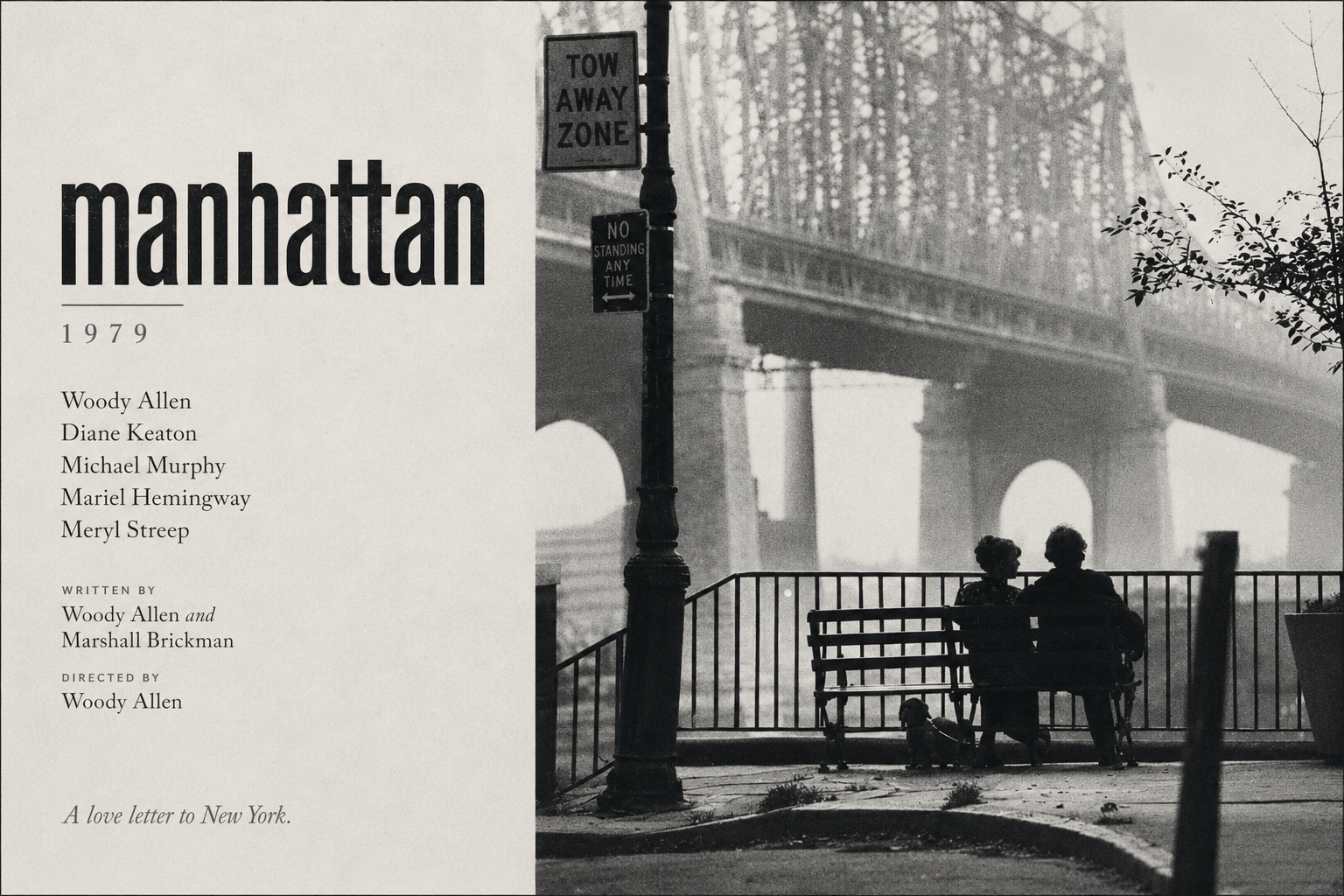
Film overview
A romantic, bittersweet portrait of New York, photographed in luminous black and white.
Television writer Isaac Davis navigates an increasingly complicated collection of relationships as he searches for certainty, fulfilment and meaning in the city he idealises.
Set to the music of George Gershwin and photographed by Gordon Willis, Manhattan presents New York as both a real city and a carefully constructed romantic dream.
Watch Manhattan
Woody Allen Films review
Review
There are films I admire, films I love, and then there is Manhattan.
From the moment George Gershwin’s Rhapsody in Blue begins and Gordon Willis’s black-and-white images of New York fill the screen, I am completely under its spell. Even after countless viewings, that opening still feels thrilling. Image, music and editing come together so perfectly that you know immediately you are watching something special.
Woody Allen’s opening narration keeps searching for the right way to describe the city. Romantic, angry, sentimental, grand. None of the versions quite satisfies him. Then the fireworks explode above the skyline and Gershwin takes over. Words are no longer needed.
That opening also tells us a great deal about Isaac Davis. He has created an idealised version of New York in his mind. The city is beautiful, cultured and dramatic because that is how he needs it to be. Unfortunately, Isaac applies the same kind of romantic editing to his own life.
He is a successful television writer who hates the programme he works on, talks constantly about artistic integrity and believes himself to be more emotionally intelligent than almost everyone around him. In reality, he is indecisive, selfish and remarkably skilled at explaining away his own behaviour.
That contradiction provides much of the film’s humour. Isaac can make almost anything sound reasonable if he talks for long enough. He is funny, articulate and often persuasive, but the film never asks us to mistake eloquence for wisdom.
Diane Keaton’s Mary is the perfect counterweight. She enters the film by insulting almost everything Isaac values. She dislikes Ingmar Bergman, dismisses Gustav Mahler and seems determined to turn every conversation into a contest. She is nervous, defensive and slightly exhausting.
And yet Keaton makes her completely captivating.
That is quite a statement when you consider Annie Hall, The Godfather films, Reds and everything else she has done. But I think Mary is her richest and most fascinating performance.
You can see the insecurity beneath Mary’s confidence almost immediately. Her opinions are often a shield, and Keaton lets us watch that shield gradually come down. The scenes between Mary and Isaac work because they are not instantly romantic. They argue, compete, irritate each other and then slowly discover that they enjoy being together.
Their walk through New York, ending beneath the Queensboro Bridge at dawn, is one of the most beautiful sequences in the film. The conversation is relaxed and unforced. For a brief moment, both characters stop performing.
That image has become so famous that it is easy to forget how perfectly the scene earns it.
Two people sitting on a bench beneath the bridge. The city quiet around them. Dawn just beginning to appear.
It is romantic without becoming sentimental, and recognisably New York without relying on the usual landmarks. You could remove the title from the film and that single image would still identify it.
Gordon Willis’s cinematography is extraordinary.
That word is probably overused, but here it is justified. The decision to shoot in black and white shapes the entire visual language of the film. Light, shadow and composition matter in every scene.
Characters are frequently placed at the edge of the frame or swallowed by darkness. In one memorable apartment scene, Isaac and Yale continue talking while barely visible. Another filmmaker might have filled the room with soft light so we could see every expression. Willis allows the darkness to remain.
The result is beautiful, but it also tells us something. These people rarely see themselves or one another clearly.
New York is photographed as Isaac wants to remember it rather than as it necessarily exists. Streets glow. Buildings become monuments. Museums, restaurants and riverside walks feel like parts of one continuous dream.
Gershwin’s music gives the film much of its emotional shape. It makes every walk, conversation and skyline feel larger. Isaac’s private complications take on the scale of a great romantic drama.
That is beautiful, but it is also funny. Isaac experiences his own life as though the entire city should stop and listen.
Mariel Hemingway gives the film its quietest and, in many ways, most moving performance.
Tracy expresses herself with refreshing directness and emotional honesty. She does not turn every feeling into an argument or every decision into a theory. That clarity makes her more emotionally perceptive than Isaac, Yale or Mary.
Hemingway never tries to make Tracy overly sophisticated. She allows her to remain young, hopeful and vulnerable. The restraint of the performance is precisely what makes it so affecting.
Isaac is not presented as someone whose judgement we should automatically trust. He repeatedly makes decisions based on what is easiest for him, then dresses them up as intellectual or moral choices. His treatment of Tracy is part of that pattern.
The film may not challenge him as directly as many viewers would now wish, but it does show the consequences of his self-deception.
Michael Murphy is excellent as Yale, a man whose dishonesty is expressed with such mildness that he almost convinces himself it is harmless. He never appears conventionally villainous, which makes him far more believable.
Meryl Streep has comparatively little screen time as Jill, but she leaves a huge impression. She sees Isaac with a clarity he cannot bear, and their exchanges are among the funniest in the film. Isaac is outraged that she is writing about their marriage, partly because he knows she understands him rather well.
The screenplay, written by Allen and Marshall Brickman, is packed with wonderful lines, but it never feels like a collection of jokes waiting for applause. The humour grows from character.
Isaac’s famous list of things that make life worth living is a perfect example. It is funny, revealing and strangely moving. Groucho Marx, Swedish films, Flaubert, Louis Armstrong, Cézanne, Marlon Brando, Frank Sinatra, the crabs at Sam Wo’s and Tracy’s face.
The list begins as another intellectual exercise. Then, almost despite himself, Isaac arrives at the truth.
That moment prepares us for the ending.
Isaac finally understands what Tracy means to him only after he has encouraged her to leave. He runs through the city to find her, but this time New York does not feel like the grand romantic playground of the opening.
He is simply a frightened man who may have realised something too late.
Their final exchange is devastating because Tracy does not deliver a great speech. She does not punish him or offer certainty. She simply asks him to have a little faith in people.
It is the wisest line in the film, and Isaac has no answer.
The slight change in Isaac’s expression. Gershwin returning. The cut to black.
Nothing is resolved, yet emotionally it feels complete.
Manhattan is often described as a love letter to New York, and of course it is. The film is equally interested in the way people turn places, relationships and even themselves into idealised versions.
Isaac loves New York partly because the city cannot argue with the version he has created. Real people are more difficult. They disappoint him, challenge him and refuse to remain inside the roles he has assigned to them.
That tension runs through every frame.
The city is magnificent. The music is magnificent. The photography is magnificent.
The people are confused, dishonest and imperfect.
That contrast is what keeps bringing me back to the film. Manhattan understands how easily intelligent people can deceive themselves, particularly when they believe their lives should resemble the films, books and music they love.
And still, after all the arguments and discomfort, I find it overwhelmingly beautiful.
Every time the skyline appears and Gershwin begins, I fall for it all over again.
Principal cast
Cast and characters
The central performances that give Manhattan its humour, tension and emotional weight.
Woody Allen
Isaac Davis
A television writer whose confidence and intelligence frequently conceal uncertainty and self-deception.
Diane Keaton
Mary Wilkie
Opinionated, anxious and intellectually competitive, Mary gradually reveals the vulnerability beneath her confidence.
Mariel Hemingway
Tracy
Sincere and emotionally perceptive, Tracy brings a refreshing directness to the film.
Michael Murphy
Yale Pollack
Isaac’s married friend, whose quiet rationalisations conceal an increasingly complicated affair.
Meryl Streep
Jill Davis
Isaac’s former wife, now writing openly about their marriage with a clarity he finds deeply uncomfortable.
Anne Byrne
Emily Pollack
Yale’s wife, whose warmth and trust give his dishonesty greater emotional consequence.
Michael O’Donoghue
Dennis
One of Isaac’s television colleagues and a sharp presence in the film’s professional world.
Karen Ludwig
Connie
A member of Isaac’s social circle who appears during the film’s gallery and conversational scenes.
Music and soundtrack
Gershwin’s New York
George Gershwin’s music gives Manhattan much of its emotional shape, lending the city romance, energy and scale.
The soundtrack moves between sweeping orchestral pieces and shorter, more intimate selections, allowing the music to follow the changing rhythm of Isaac’s New York.
Opening and closing composition
Rhapsody in Blue
George Gershwin
The famous clarinet opening begins as Isaac searches for the right words to describe New York. As the music builds, narration gives way to the skyline, crowded streets and fireworks above the city.
Its return at the end brings the film full circle, connecting Isaac’s private uncertainty with the city he continues to romanticise.
- Composer
- George Gershwin
- Piano
- Gary Graffman
- Orchestra
- New York Philharmonic
- Conductor
- Zubin Mehta
- Written
- 1924
Featured compositions
Music heard throughout the film
- 01 Rhapsody in Blue
- 02 Land of the Gay Caballero
- 03 Someone to Watch Over Me
- 04 I’ve Got a Crush on You
- 05 Do, Do, Do
- 06 Mine
- 07 He Loves and She Loves
- 08 Love Is Here to Stay
- 09 Love Is Sweeping the Country
- 10 Sweet and Low Down
- 11 ’S Wonderful
- 12 Oh, Lady Be Good!
- 13 Strike Up the Band
- 14 Embraceable You
- 15 But Not for Me
Filming locations
New York on screen
The city is central to Manhattan. Museums, restaurants, streets and riverside views become part of the film’s emotional landscape.
Defining location
Riverview Terrace and the Queensboro Bridge
Sutton Square, East 59th Street
Isaac and Mary sit beneath the bridge as dawn begins to appear over the East River. The stillness of the moment provides a striking contrast to the anxious conversations and complicated relationships surrounding it.
The resulting composition became the film’s most recognisable image and remains closely associated with Woody Allen’s vision of New York.
The city becomes quiet enough for Isaac and Mary to stop performing and simply enjoy one another’s company.
Museum
Solomon R. Guggenheim Museum
1071 Fifth Avenue
Isaac first meets Mary during an exhibition inside Frank Lloyd Wright’s distinctive spiral museum. Their conversation quickly becomes a contest of opinions and cultural judgements.
Museum
Museum of Modern Art
11 West 53rd Street
Isaac and Mary meet again in the museum’s sculpture collection. Their guarded hostility begins to soften into curiosity and attraction.
Museum and planetarium
Hayden Planetarium
American Museum of Natural History, Central Park West
An electrical storm sends Isaac and Mary indoors, where the darkness and celestial displays create one of their most intimate and visually memorable encounters.
Restaurant · Closed in 2011
Elaine’s
1703 Second Avenue
The opening restaurant scene brings Isaac, Tracy, Yale and Emily together and immediately establishes the relationships and tensions that will shape the film. The celebrated Upper East Side restaurant closed in 2011 after nearly five decades.
Restaurant
John’s of Bleecker Street
278 Bleecker Street
Tracy tells Isaac about her plans to study in London during a conversation at this Greenwich Village pizzeria.
Food shop
Zabar’s
2245 Broadway
Isaac and Mary browse the Upper West Side food emporium as their relationship becomes increasingly relaxed and familiar.
Awards and recognition
An acclaimed New York story
The film received major recognition for its screenplay, performances, direction and distinctive black-and-white photography.
British Academy Film Awards
Two BAFTA wins
Manhattan was named Best Film, while Woody Allen and Marshall Brickman won for their screenplay.
Winner
Best Film
Woody Allen
Winner
Screenplay
Woody Allen and Marshall Brickman
Academy Award nomination
Actress in a Supporting Role
Mariel Hemingway
Academy Award nomination
Screenplay Written Directly for the Screen
Woody Allen and Marshall Brickman
Golden Globe nomination
Best Motion Picture – Drama
Manhattan
Further BAFTA recognition
Eight additional nominations
- Direction — Woody Allen
- Actor — Woody Allen
- Actress — Diane Keaton
- Supporting Actress — Mariel Hemingway
- Supporting Actress — Meryl Streep
- Cinematography — Gordon Willis
- Film Editing — Susan E. Morse
- Soundtrack — James Sabat, Dan Sable and Jack Higgins